
Introduction
A proposed community battery in Narrabri shows that technically sound infrastructure can still lose public confidence when communities do not clearly understand the risks, benefits and safeguards. The case highlights why Social Impact Assessment should not be treated as a late-stage compliance exercise, but as an early tool for listening, explaining and building trust around projects that affect local communities.
What is a Battery Energy Storage System?
Battery Energy Storage Systems are becoming increasingly important as Australia increases its use of renewable energy. A Battery Energy Storage System (BESS) stores electricity generated from sources such as solar and wind, then releases that electricity when demand is high or renewable generation is low (GSL Energy, 2025). In practical terms, BESS technology helps balance electricity supply and demand and supports the transition to a cleaner, lower-carbon energy system.
Lithium-ion batteries are used in Battery Energy Storage Systems (BESS) because of their high energy density, efficiency and long operational lifespan (NSW Government, 2026). In Australia, they are generally classified as Class 9 Miscellaneous Dangerous Goods under the Australian Dangerous Goods Code for transport purposes, reflecting the fire, thermal runaway and other hazards they may present. Additional storage and operational requirements may also apply under work health and safety, fire safety, electrical safety and industry-specific regulations. This distinction matters because smaller consumer-scale batteries, standalone batteries in transport or storage, and large-scale operating BESS installations may be regulated differently depending on their context and use.
However, technical benefits alone do not determine whether infrastructure is accepted. For communities, perceived risk, trust in project proponents, confidence in emergency management arrangements, and access to clear information can be just as influential as the engineering design itself.
The Narrabri Battery Project
Narrabri is a regional town in north-west New South Wales with high levels of rooftop solar uptake. This may indicate community interest in renewable energy, but it does not automatically translate into acceptance of new or less familiar infrastructure, such as large-scale Battery Energy Storage Systems (BESS).
In 2025, a 500 kWh community battery was proposed for Narrabri, backed by federal funding and intended to store excess local solar energy. The project did not proceed as planned after local opposition escalated and council support shifted. Community perceptions of risk were influenced by discussion of lithium-ion battery hazards, including comparisons with smaller consumer batteries such as those used in e-bikes (Davis, Morris, & Lim, 2026).
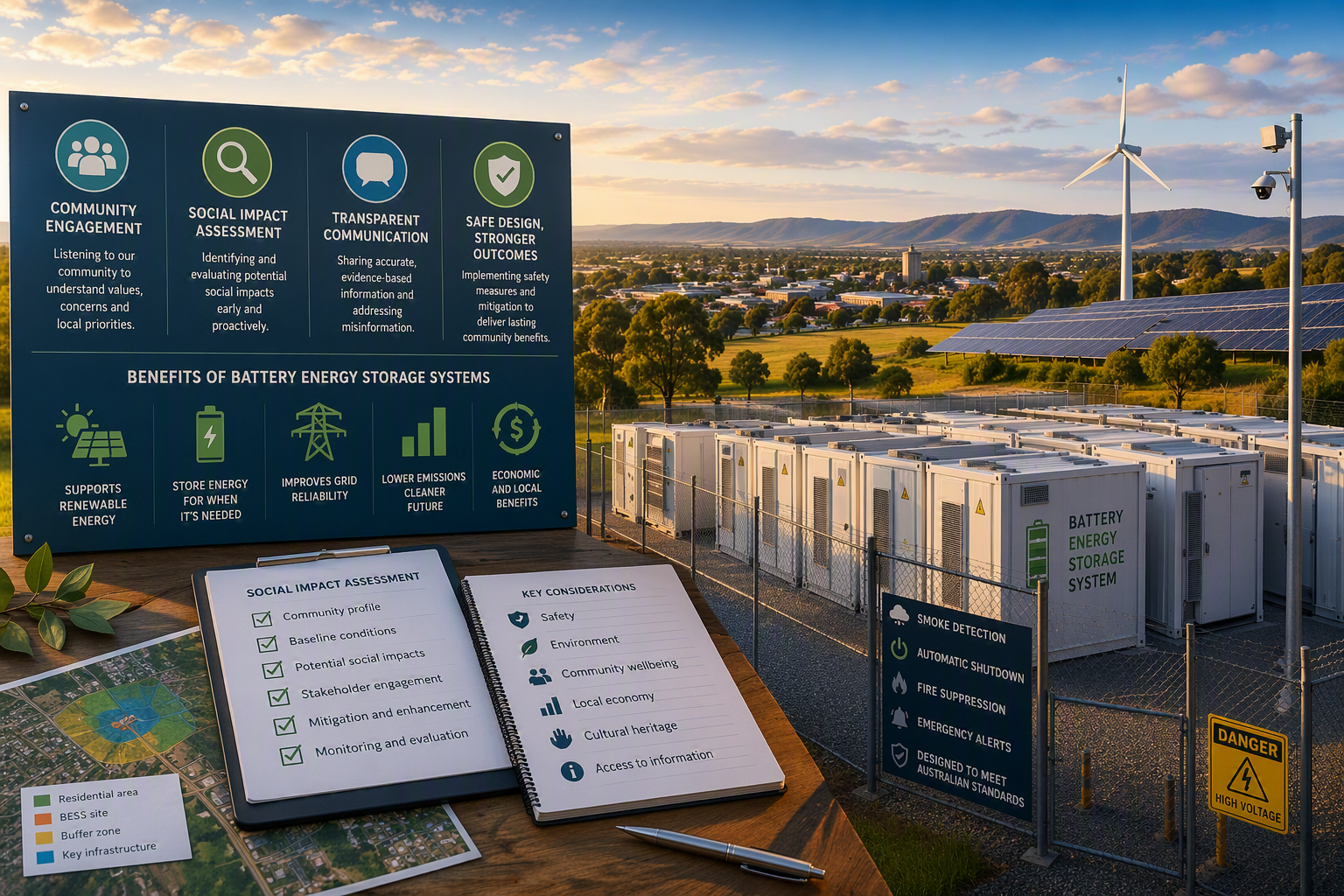
Despite these concerns, community batteries are generally designed with layered safety controls, which may include monitoring systems, emergency shutdown functions, fire detection and emergency response procedures. In the Narrabri case, the key issue was not only whether safeguards existed, but whether those safeguards were clearly explained, understood and trusted by the community.
The Narrabri case therefore raises a broader question for infrastructure proponents: how can technical information, risk controls and community concerns be brought together early enough to support informed decision-making?
Social Impact Assessment and Community Engagement
A Social Impact Assessment (SIA) is a structured process for understanding how a project may affect people, communities and local places (NSW Department of Planning, Housing and Infrastructure, 2026). It identifies likely social impacts, considers the social locality of the host suburb and broader Local Government Area (LGA), and helps assess how different groups may experience project-related changes. Community engagement is central to this process because it enables project information to be shared, community concerns to be identified and local values to be understood.
Social impacts are not experienced uniformly. They vary across individuals and groups depending on factors such as location, age, income, mobility, cultural connection, access to information and reliance on local services. Community engagement helps identify these differences and informs mitigation strategies for adverse impacts and enhancement measures for positive outcomes. Early and meaningful engagement can reduce project-related risks, improve community understanding and contribute to greater social acceptance (NSW Department of Planning, Housing and Infrastructure, 2026).
A well-structured SIA also supports transparent communication between project proponents and the community. It can help address misinformation, build trust, and provide decision-makers and affected stakeholders with accurate, reliable, and accessible information before a project is implemented.
In the Narrabri case, community engagement activities were undertaken, but technical information about Battery Energy Storage Systems (BESS) did not appear to resolve community concerns. Greater involvement of independent subject-matter experts could have helped explain the differences between consumer lithium-ion battery risks and monitored community battery systems. The project therefore highlights a gap in risk communication: communities need timely, credible, and accessible information before concerns become entrenched. A more structured and proactive SIA process, incorporating early technical input, could have strengthened trust and improved confidence in the project’s risk mitigation measures.
Conclusion
The proposed Battery Energy Storage System in Narrabri demonstrates that community acceptance is a critical part of infrastructure delivery. A structured and proactive Social Impact Assessment (SIA) process can help identify social impacts, facilitate meaningful engagement and support transparent risk communication. By involving subject-matter experts early and responding to community concerns with credible and accessible information, proponents can reduce misinformation, build trust and improve the prospects of delivering infrastructure that is both technically sound and socially acceptable.
References
- Davis, J., Morris, N., & Lim, A. (2026, February 28). How to kill a battery. Retrieved from ABC News: https://www.abc.net.au/news/2026-02-28/misinformation-kills-narrabri-community-battery-project/106120264
- GSL Energy. (2025, June 11). What is BESS? A Comprehensive Overview of Battery Energy Storage Systems. Retrieved from GSL Energy: https://www.gsl-energy.com/what-is-bess-a-comprehensive-overview-of-battery-energy-storage-systems.html
- NSW Department of Planning, Housing and Infrastructure. (2026). Social Impact Assessment Guideline: For state significant projects. Sydney: NSW Government.
- NSW Government. (2026). Lithium-ion batteries. Retrieved from SafeWork NSW: https://www.safework.nsw.gov.au/hazards-a-z/lithium-ion-batteries