
Introduction
Renovation and alteration works are among the most common triggers for fire safety non-compliances matters existing buildings. A seemingly straightforward office refurbishment, a new partition wall in a warehouse, or a layout change in a manufacturing facility can each have far-reaching consequences for occupant safety, fire compartmentation, and compliance with the National Construction Code (NCC). For building owners and tenants planning alteration works, understanding the approval pathways, applicable codes, and when specialist advice is required can mean the difference between a smooth project and a costly, time-consuming remediation effort.
What are Class 5, 7b and 8 Buildings?
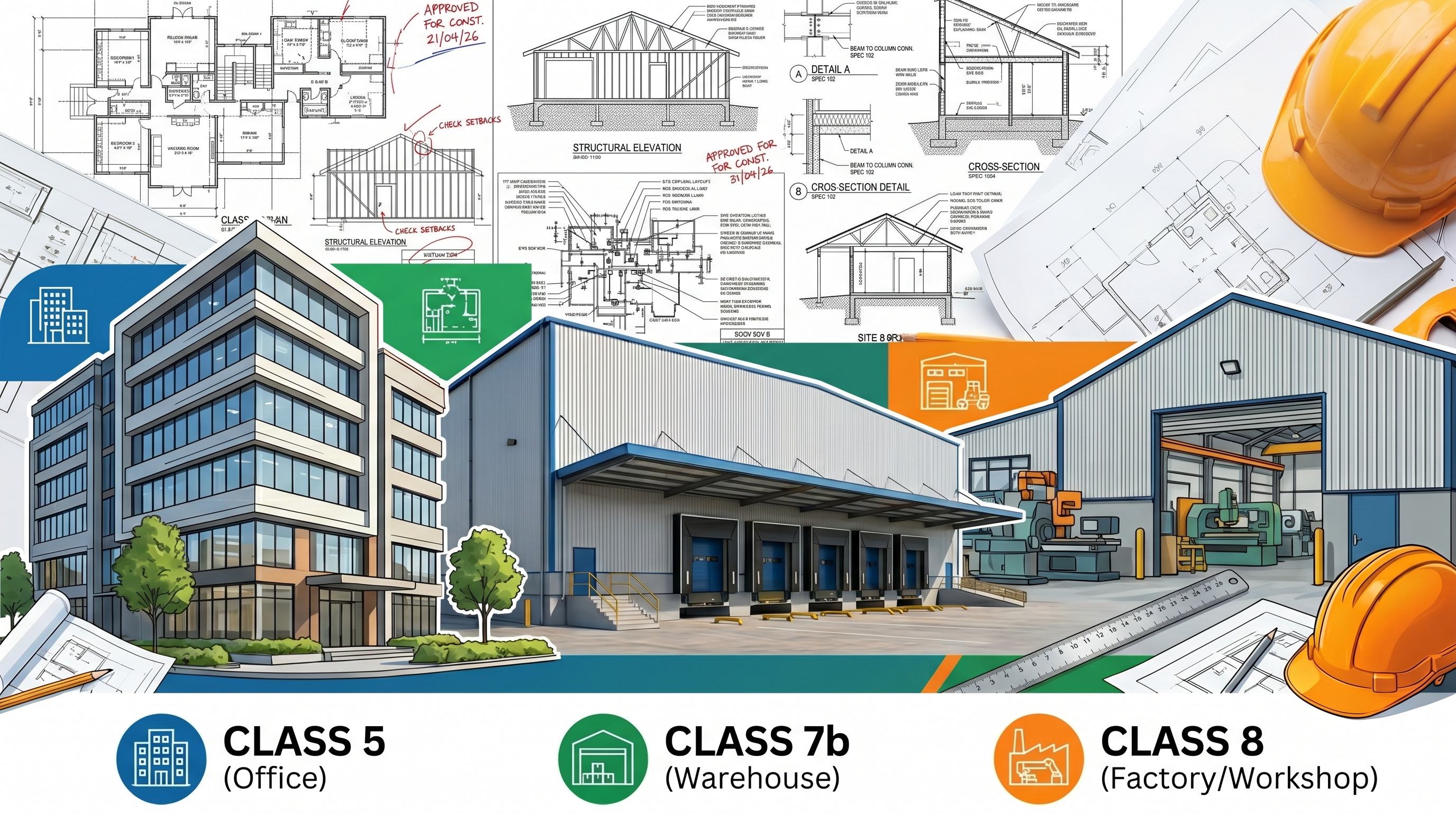
Before diving into the compliance landscape, it is worth clarifying the building classifications this article addresses. Under the National Construction Code (NCC), a Class 5 building is a commercial office building. A Class 7b building is a warehouse or storage facility, and a Class 8 building is a factory, laboratory, or other building used for production or manufacturing. These building types are grouped together here because they share similar occupancy characteristics and face comparable compliance challenges when alteration works are undertaken.
Development Pathways for Alterations Works in NSW?
Clause 14 of the Environmental Planning and Assessment (Development Certification and Fire Safety) Regulation 2021 defines alteration works “as new building works involving alterations to an existing building without a change of use generally follow one of three (3) approval pathways.
The first is exempt development, which covers minor works that do not require planning or building approval. These are detailed in the State Environmental Planning Policy (Exempt and Complying Development Codes) 2008.
The second pathway is Complying Development Certificate (CDC), which is a combined planning and construction approval suitable for standard works that can be assessed by Council or Private Certifier, often within as little as 20 days.
The third and most formal pathway is the Development Application (DA), which is required for works that may impact the surrounding environment or amenities. A DA is followed by a Construction Certificate (CC), which confirms that the proposed works are consistent with the development consent and comply with the NCC.
This article focuses on CDC (pathway 2) or DA and CC (pathway 3), as these are where fire safety non-compliances are commonly triggered.
Applying Current Codes to existing buildings
One of the challenges in alteration works is understanding how current codes and standards apply to buildings that were designed and constructed under older regulatory frameworks. It is a common misconception that an existing building must be fully upgraded to current NCC Deemed-to-Satisfy (DtS) provisions whenever works are undertaken. The ABCB Upgrading Existing Buildings Handbook acknowledges that codes evolve in both directions some requirements have become more stringent over time, while others have relaxed. A building that does not comply with a current NCC DtS provision may still fully satisfy the underlying performance requirements of the NCC.
To navigate this, the ABCB Handbook outlines a five-step scoping process. In brief, this process involves identifying the current use and fire safety provisions of the building, assessing potential deficiencies against current performance requirements, determining whether those deficiencies are actual non-compliances using recognised assessment methods, and then addressing confirmed deficiencies through either a NCC DtS upgrade or a Performance Solution. Engaging a Private Certifier early in this process is strongly recommended to ascertain that deficiencies are correctly identified and assessed.
Common Fire Safety Deficiencies in Alteration Projects
Several recurring deficiencies tend to emerge across access and egress, fire resistance, and fire services. In terms of egress, works such as new partition walls, layout reconfigurations, or temporary installations can extend travel distances to exits or obstruct previously compliant exit paths. These issues are assessed against Section D of NCC 2022 Volume One.
Fire resistance deficiencies, governed by Section C, are commonly triggered by changes to compartmentation boundaries, new openings, additional service penetrations, or modifications to load-bearing elements. Even a single new penetration through a fire-rated wall, if not correctly fire-stopped, can compromise the integrity of an entire fire compartment. This is where attention to detail during construction is critical.
Fire services, covered under Section E, are frequently affected by layout changes that alter the geometry of a tenancy or compartment. Sprinkler coverage, exit signage placement, and detector distribution are all designed around a specific spatial configuration when that configuration changes, the existing fire services design may no longer be adequate.
When Should a Fire Safety Engineer Be Engaged?
Where a Performance Solution is required to address fire safety deficiencies, the NSW Environmental Planning and Assessment Regulation requires a Fire Engineering Report prepared by an Accredited Certifier - Fire Safety (formerly C10 Certifier).
A CDC / CC cannot be issued for alteration works unless the fire protection and structural capacity of the building is not reduced because of the works. This encompasses structural load-bearing capacity, measures to protect and facilitate the egress of occupants, and the ability to restrict the spread of fire to adjoining properties.
Engaging a Fire Safety Engineer as early as possible allows potential issues to be resolved efficiently and cost-effectively. A qualified engineer can assess the overall fire protection strategy of the building, identify where current provisions fall short, and develop bespoke Performance Solutions that satisfy the NCC requirements without necessitating a full DtS upgrade of the entire building.
If you are planning alteration works to a Class 5, 7b, or 8 building in NSW, early engagement with both a Private Certifier and a Fire Safety Engineer is strongly recommended. Identifying compliance obligations at the outset of a project is significantly less disruptive and less expensive than addressing them after works have commenced or, worse, after a final inspection has failed.
Conclusion
Alteration works to existing commercial and industrial buildings carry compliance obligations that are easy to underestimate. The good news is that full compliance does not always mean a full upgrade with the right expertise applied at the right time, Performance Solutions can provide practical, cost-effective pathways without overhauling an entire building. The key takeaway is simple: do not treat fire safety compliance as an afterthought. Engage a Private Certifier early, and where a Performance Solution is required, bring a qualified Fire Safety Engineer into the conversation from the outset. A proactive approach protects your occupants, your timeline, and your budget.
References
- Australian Building Codes Board. (2022). Handbook: Upgrading existing buildings. https://www.abcb.gov.au/sites/default/files/resources/2022/Handbook-upgrading-existing-buildings.pdf
- Australian Building Codes Board. (2024). NCC 2022 performance solution process handbook. https://www.abcb.gov.au/sites/default/files/resources/2024/NCC%202022-%20Performance%20Solution%20Process%20handbook.pdf
- NSW Government. (2021). Environmental Planning and Assessment (Development Certification and Fire Safety) Regulation 2021. https://legislation.nsw.gov.au/view/whole/html/inforce/2026-04-01/sl-2021-0689
- NSW Government. (2023). Guide to complying development. https://www.planning.nsw.gov.au/sites/default/files/2023-02/guide-to-complying-development.pdf
- NSW Government. (2023). Merit assessment policy. https://www.nsw.gov.au/sites/default/files/2023-04/Merit-Assessment-Policy.pdf
- NSW Government. (2023). Understanding exempt development. https://www.planning.nsw.gov.au/sites/default/files/2023-02/understanding-exempt-development.pdf
- NSW Government. (2023). Your guide to the DA process: Small housing development. https://www.planning.nsw.gov.au/sites/default/files/2023-02/your-guide-to-the-da-process-small-housing-development.pdf