
Introduction
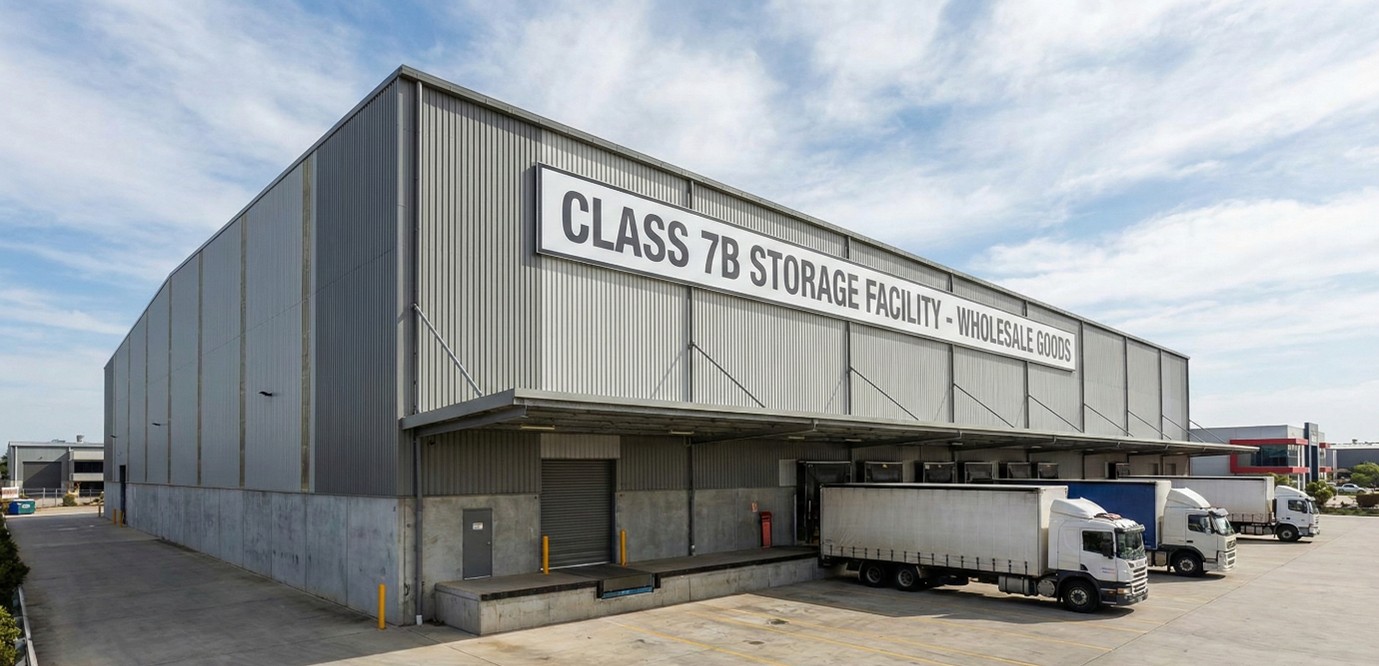
In February 2025, over 100 firefighters and 25 fire trucks rushed to a warehouse factory in Marrickville to contain a fierce fire for approximately four hours (Fire & Rescue NSW, 2025). At Lote, we are always looking to adapt the fire safety strategies we implement to serve the current environment. A Class 7b building is defined as: ‘A building that is for storage or display of goods or produce for sale by wholesale’ (NCC, 2024). It is helpful to view Class 7b as the standard classification for warehouses, storage facilities, and logistics hubs that do not serve the general public directly in a retail capacity. With Class 7b industrial fire incidents increasing in frequency through 2025, it is important to review and understand the strategies used to mitigate these risks. This has sparked discussion among the Lote team on the fire safety strategies proposed for this classification of buildings.
Class 7b Fire Risks
Before attempting to create strategies to mitigate fire risk in Class 7b buildings, we must understand the fire risks that are associated with this unique classification. Class 7b buildings present various fire risks prompted by the nature and purpose of the facility. High fuel loads, hazardous goods and large open compartments are typical characteristics found in Class 7b buildings.
A high fuel load is typically found within Class 7b buildings as most of them are used with the intent of storing or displaying goods. For example, a warehouse which packages and stores goods will generally contain large quantities of carboard boxes, resulting in a highly combustible fuel load.
Whilst not present in every Class 7b building, hazardous materials can be present and pose a high safety risk due to the flammability of the material. A recent example of the risk of hazardous goods was in the North St Mary’s chemical factory fire, which resulted in a 15 m high explosion.
A major distinction of Class 7b buildings compared to other classifications are the lack of fire compartments present. Typically, warehouses comprise of one large open space, only separated by fire rated construction between the inside and outside. Since fire compartmentation provides protection to occupants in rooms fire separated from the fire, the lack of compartmentation creates a risk to all occupants inside the building.
The above-mentioned factors foster an ideal environment for extreme fire growth and when not properly considered in a fire safety assessment, the impact can be detrimental to occupants.
Fire Risk Mitigation Strategies
To mitigate the fire risks associated with Class 7b buildings, a combination of active and passive fire safety measures along with building layout provisions allow for safer Class 7b buildings.
A sprinkler system, smoke detection system and building occupant warning system are active fire safety systems that can be deployed. It is important to note that these systems are not BCA Deemed-to-Satisfy (DtS) for one storey, less than 2000 m2 or less than 25 m in effective height Class 7b buildings. Therefore, in many cases, the addition of these systems would be upgraded beyond DtS requirements. Despite that, the combination of these active fire safety systems provides earlier notification for occupants via the smoke detectors and a method of automatic fire suppression via the sprinklers. As a further measure, upgrading to an aspirated smoke detection (ASD) system can be beneficial to provide earlier detection due to the system’s ability to detect changes in air molecules at extremely low concentrations. However, according to a study by the Department of HVAC & Firefighting Engineering at Gachon University, a warehouse that stores combustibles with high fire growth rates would benefit most from an ASD system and additional smoke detectors positioned far from the ASD receiver (SangBum Lee et al., 2023). This proves that analysing the fire safety needs of a Class 7b building beyond what is only required by the BCA can potentially create lower risk and safer buildings.
Despite the rarity of multiple fire compartments in Class 7b buildings, providing fire separation where possible is crucial. Providing suitable fire separation between the general open area and hazardous goods storage is an effective method of separating a dangerous area to the general compartment. Fire separation through fire rated construction and automatic fire rated shutters will allow for protection in adjacent compartments, while still providing access for staff to operate. Additionally, providing fire separation with other classed portions, such as a Class 5 office, are common passive fire safety measures to mitigate risk through compartments.
The large open compartment commonly found in Class 7b buildings creates a dangerous fire risk in one unprotected area. Whilst the former is true, the large space also allows for a large smoke compartment which allows for smoke to be logged at the ceiling. Additionally, the large open space provides easy wayfinding for occupants, given proper exit signage, emergency lighting and floor markings is provided. Combining these measures allows for quicker occupant evacuation and prevents confusion during a fire scenario.
In the case that a fire does occur, providing fire brigade access is paramount to stopping the fire. Since Class 7b buildings typically have large areas, providing perimeter vehicular access and a suitable amount of access points for the fire brigade will allow for quicker fire brigade intervention. The addition of DtS internal fire hydrants near the building will aid the fire brigade to do their job effectively. Furthermore, installing Fire Detection and Indicating Equipment (FDCIE) in the building connected to the relevant detection systems will provide early warning for occupants and the fire brigade personnel.
A combination of all the above, both DtS required and beyond, provide Class 7b buildings with the fire safety measures to keep the occupants and the building safe.
Conclusion
In conclusion, by understanding the fire risks present in Class 7b buildings and analysing the recent fires occurring, effective fire safety strategies can be formulated to provide better safety for the future of Class 7b buildings. The combination of active and passive fire safety measures provides the foundational framework for occupant safety. This coupled with the unique building characteristics of Class 7b buildings allows for innovative performance-based design.
References
- Fire & Rescue NSW. (2025, February 20). Major factory fire and multiple blazes contained overnight—Sydney. https://www.fire.nsw.gov.au/incident.php?record=rec4fUDt1b9Jy9sjt
- National Construction Code. (2024, September 30). Building classifications. https://ncc.abcb.gov.au/ncc-navigator/building-classifications
- SangBum Lee, MinSeok Kim, & SeHong Min. (2023). A Study on the Comparison of Aspirating Smoke Detector and General Smoke Detector Detection Time according to the Fire Speed and Location of Logistics Warehouse through FDS. Gachon University. https://doi.org/10.15683/kosdi.2023.9.30.608