
Introduction
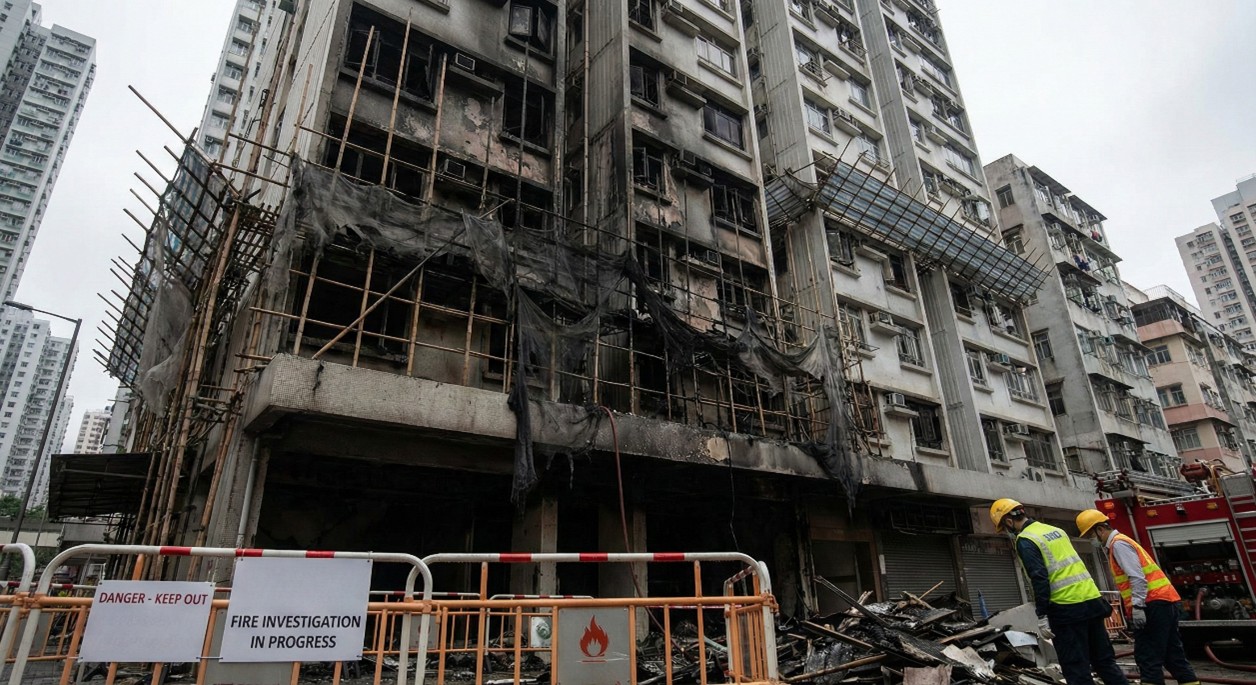
The tragic loss of 168 lives during an apartment fire in Hong Kong has brought to light vulnerabilities in building renovation, fire safety systems, regulatory oversight and emergency response protocols, including a comparison of the Australian landscape for high-rise apartments.
The Incident
Wang Fuk Court was a subsidised Government Housing complex comprising eight 31 storey apartment buildings. Overall, there were 2,000 units and 4,643 residents, with local census data noting that the around 40% of all the residents were aged 65 and over. As part of a large-scale remediation works, a builder was engaged to rebuild the exterior walls.
A fire started on the 26th of November 2025 in Block F and rapidly spread to other buildings via the materials selected for the refurbishment. The fire was finally extinguished 43 hours later on the 28th of November 2025.
Initial investigations following the fire noted that the likely three root causes and contributing factors leading to the extensive fire spread were:
- The extensive use of flammable materials, such as the scaffold netting and the expanded polystyrene foam boards installed as temporary measures to protect windows. Furthermore, the use of bamboo scaffolding contributed to the spread of fire from one tower to another.
- The chimney effect phenomena that accelerated the vertical fire spread up each building based on the scaffolding netting.
- Fire alarm systems across the complex were not operational and had been disabled for builder convenience.
Key Differences Between Australia and Hong Kong
This incident draws many similarities to the 2017 Grenfell Tower incident in which combustible cladding led to rapid fire spread pathways up the building. Following which numerous Australian states developed cladding remediation programs, all of which are proactive programs. In comparison to Hong Kong where a reactive approach was adopted, with the local cladding standards being updated following another fire incident in China a month prior to the Wang Fuk Court fire.
The Australian National Construction Code (NCC) Clause E1D4 outlines that sprinklers must be provided throughout Class 2 (residential apartments) buildings that are greater than four storeys. Whereas Hong Kong still utilises the 25m rule for fire sprinklers.
What can be applied to Australia
Despite the more robust local framework, there are lessons that can be learnt following the Wang Fuk Court fires.
The deliberate decision to disable the building’s fire alarm system for the builder’s convenience highlights significant concerns within the local fire‑safety framework. One recommendation is that disabling the fire alarm system during construction or renovation works should be prohibited, unless an alternate system is provided. Furthermore, a fire watch procedure should be adopted for fire safety systems that need to be disabled or taken offline.
The aged demographic of the Wang Fuk Court presented challenges during the occupant evacuation. With the general ageing population of Australia and the overall shift towards apartment living, a further recommendation would be to address the evacuation of elderly and impaired residents as part of the AS 3745 emergency planning.
Material substitutions can lead to situations that may compromise overall safety. The original approved fire-retardant scaffold netting was substituted with a lower grade unapproved product that was a result of project value engineering by the Builder. Unfortunately, in Australia there are currently no legislative means to ascertain that materials do not change from what was approved to what is finally used. Where fire safety engineers are involved, such matters are often raised at the design stage. However, there would be concerns where fire engineers are not involved and who the decision rests with. As such, it is recommended that where façade remediation works are required, input from a fire safety engineer must be sought.
The parallels between the Wang Fuk Court fire and 2017 Grenfell Tower fire cannot be ignored as both involved combustible materials contributing to rapid fire spread pathways up the buildings. Learning from Grenfell, reforms were introduced in Australia demonstrating that proactive approaches to overall building safety is better than a reactive one.
Conclusion
Fire safety must never be treated as a box-ticking exercise. It is a moral responsibility rooted in the protection of human life. The Wang Fuk Court fire is a stark reminder that cost-cutting decisions in construction can result in losses. For those of us working in building design, fire engineering, construction management, and regulatory oversight, this underscores a shared duty: safety must never be compromised for convenience or profit.
As we remember the 168 lives lost in the Wang Fuk Court fire, we must ensure that their legacy is one of action, not repetition. By turning grief into resolve, we can strengthen fire safety standards and help prevent future tragedies both locally and globally.